Music News
The Grand Return: Dissecting My Chemical Romance’s The Black Parade Asia Tour 2026
Oct
The Enduring Conceptual Architecture of The Black Parade
Helmed by producer Rob Cavallo, The Black Parade was a deliberate departure from the stripped-down, visceral punk style that defined 2004’s Three Cheers for Sweet Revenge. Instead, Gerard Way, Ray Toro, Frank Iero, and Mikey Way reached toward classic stadium rock traditions, absorbing the theatrical grandeur of Queen, the narrative depth of David Bowie’s Ziggy Stardust era, and the cinematic ambition of Pink Floyd’s The Wall. At its core, the album traces the journey of “The Patient,” a character grappling with a terminal diagnosis whose passage into death is guided by an ornate, haunting marching band—a manifestation of his strongest childhood memory.
From the iconic, lone piano G-note that opens “Welcome to the Black Parade” to the fierce, survivalist defiance of “Famous Last Words,” the album demonstrated that heavy, emotional themes could exist alongside intricate musicality. Ray Toro’s layered guitar harmonies, coupled with dynamic shifts between abrasive punk tempos and sweeping brass arrangements, turned existential dread into a cathartic community experience. Rather than fading into nostalgia, the narrative of enduring despite overwhelming despair has cemented the album as an enduring cornerstone of 21st-century rock music.
Why the Asian Leg Represents a Vital Milestone
While stadium spectacles in North America and Western Europe often dominate headlines, My Chemical Romance’s connection with Asia runs just as deep. Since their initial regional visits in the mid-2000s, Asian audiences have maintained a remarkably loyal presence within the international “MCRmy.” Throughout the band’s prolonged hiatus from 2013 to 2019, listenership in major Asian urban centers did not dwindle; it expanded as online fan communities preserved the album’s visual art, narrative lore, and music videos.
The 2026 tour reflects an intentional commitment to bring this massive production directly to these dedicated territories. Rather than restricting the anniversary celebration to brief festival appearances, the band mapped out a dedicated, multi-week arena and stadium route across East and Southeast Asia. The schedule ensures that regional audiences experience the complete sonic drama of The Black Parade on a scale matching its historical importance.
Confirmed Asia Tour Schedule and City-by-City Analysis
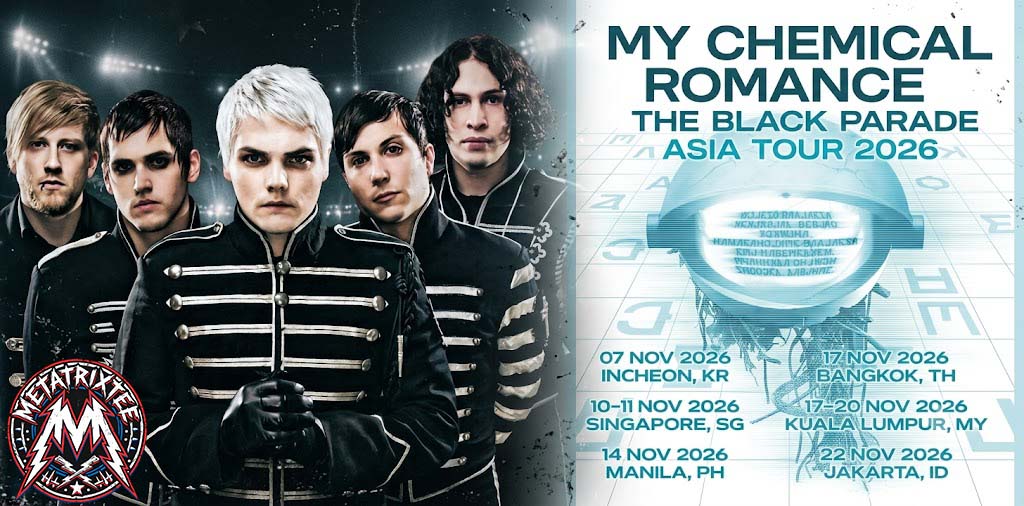
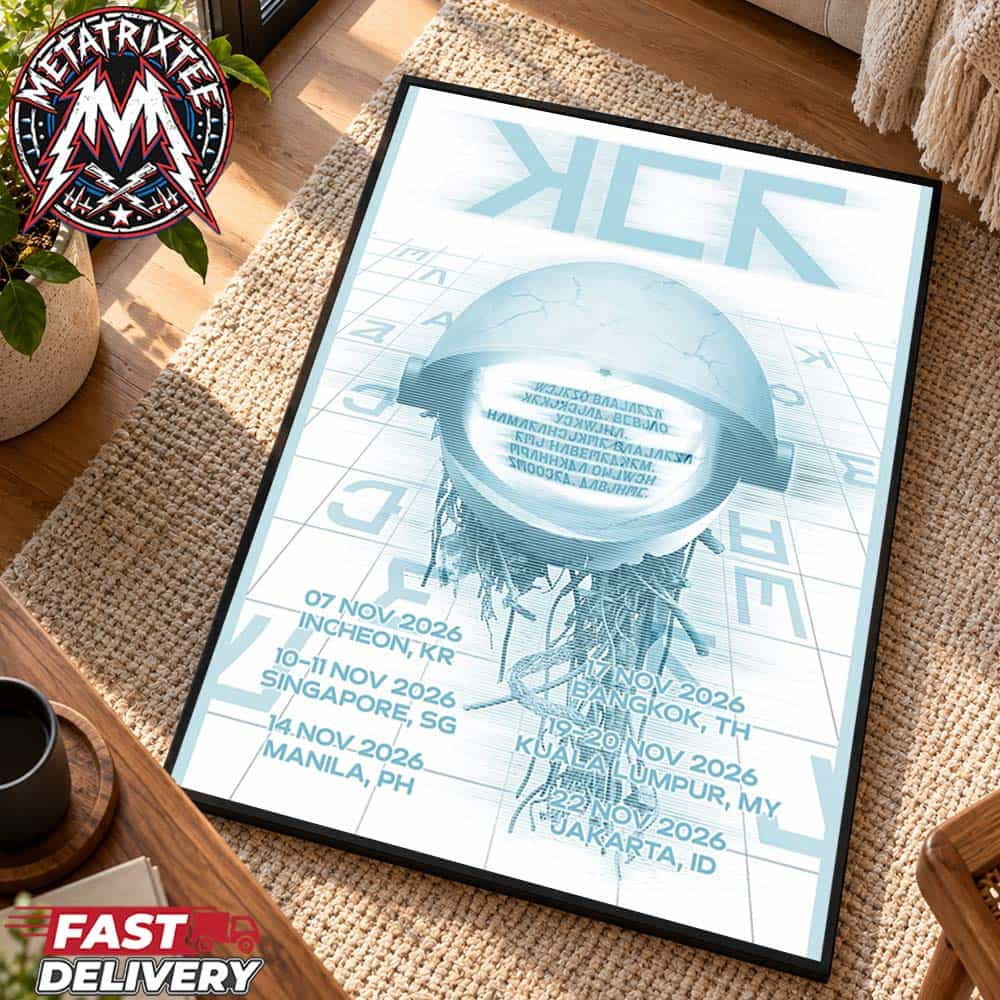
Spanning November 2026, the Asian schedule stops in six major music hubs across South Korea, Singapore, the Philippines, Thailand, Malaysia, and Indonesia. Official routing and tour itinerary updates are maintained directly on My Chemical Romance’s Official Website.
| Date | City | Country / Territory | Venue / Setting |
|---|---|---|---|
| 07 November 2026 | Incheon | South Korea | Paradise City Culture Park |
| 10–11 November 2026 | Singapore | Singapore | Singapore Indoor Stadium |
| 14 November 2026 | Manila (Bulacan) | Philippines | Philippine Arena |
| 17 November 2026 | Bangkok | Thailand | Impact Challenger Hall |
| 19–20 November 2026 | Kuala Lumpur | Malaysia | National Stadium Bukit Jalil |
| 22 November 2026 | Jakarta | Indonesia | Hammersonic Festival Grounds |
Incheon, South Korea: Launching the Continental Journey
The tour opens on 7 November 2026 in Incheon at Paradise City Culture Park. Serving as the primary kickoff date for the entire Asian route, the South Korean performance sets the tone for the production. Seoul and Incheon have historically served as hubs for ambitious live entertainment in East Asia, providing a world-class outdoor stage setting capable of accommodating the theatrical visual identity and massive crowd that The Black Parade commands.
Singapore: High Demand Demands Consecutive Nights
Moving south on 10 and 11 November 2026, the band settles into the Singapore Indoor Stadium for an intensive two-night residency. Serving as a central gathering point for fans across Southeast Asia, Singapore became one of the key stops on the routing to require back-to-back performances. The indoor arena setting offers tightly controlled acoustics, allowing the layered vocal counterpoints and dynamic crescendos of songs like “Sleep” and “Mama” to hit with studio precision.
Manila (Bulacan), Philippines: The Stadium-Scale Spectacle
On 14 November 2026, the tour heads to Bulacan, just outside Manila, to play the colossal Philippine Arena. The Philippines has long maintained one of the most fervent alternative rock followings in the world. Placing the concert inside one of the largest indoor arenas on the globe underscores the massive cultural footprint My Chemical Romance has held in the country since the mid-2000s, guaranteeing an electric, unified chorus of tens of thousands of voices for “Helena” and “Teenagers.”
Bangkok, Thailand: Bringing Theatricality Indoors
The tour continues westward to Thailand on 17 November 2026, taking over Bangkok’s Impact Challenger Hall. Bangkok’s diverse live-music scene has consistently welcomed international alternative acts, and this stop provides a dedicated space where the narrative lighting, elaborate stage dressings, and visual projections of the band’s fictional marching unit can be fully deployed.
Kuala Lumpur, Malaysia: A Two-Date Stadium Stance
On 19 and 20 November 2026, the band mounts a massive two-night stand at the prestigious National Stadium Bukit Jalil in Kuala Lumpur. Malaysia’s alternative music community has celebrated MCR since their early days, and securing one of the largest athletic stadiums in Southeast Asia for consecutive evenings highlights the monumental draw of the twentieth-anniversary campaign in the region.
Jakarta, Indonesia: The Grand Continental Finale
The tour reaches its climax on 22 November 2026 in Jakarta, taking center stage at the legendary Hammersonic Festival grounds. Indonesia’s rock, metal, and alternative communities are renowned for their raw energy and dedication. Staging the final Asian performance in Jakarta provides a fittingly explosive conclusion to an intensive, two-week continental campaign.
Visual Identity, Lore, and the Enduring Subculture
A significant reason The Black Parade has retained such high cultural currency is its complete, cohesive aesthetic framework. Rather than simply touring behind songs, the band adopted an alternate persona—complete with charcoal-washed military marching jackets, brass buttons, theatrical face makeup, and gothic Victorian undertones. This imagery created an immersive universe that fans did not merely listen to, but actively adopted into their personal subcultural identity.
Over the past twenty years, this distinctive gothic-romantic aesthetic has evolved into a staple of modern alternative fashion and lifestyle design. Longtime admirers and new enthusiasts alike celebrate this aesthetic legacy through curated apparel, often exploring a My Chemical Romance collection to discover graphic pieces inspired by the marching band motifs and dramatic lyricism that defined the 2006 era.

Two Decades Later: Critical Vindication and Multi-Generational Impact
In the years immediately following its release, The Black Parade was occasionally misunderstood by mainstream rock traditionalists who struggled with its unrestrained theatricality. However, retrospective essays and long-form appraisals from premier music outlets such as Pitchfork and Billboard have firmly reversed that narrative. Today, the record is widely recognized as a monumental classic of 2000s rock—a fearless conceptual achievement that demonstrated mainstream punk bands could execute high-concept artistry with intellectual and emotional depth.
This critical reassessment mirrors the evolving demographics inside concert venues. The audiences gathering across Incheon, Singapore, Manila, Bangkok, Kuala Lumpur, and Jakarta are not homogeneous nostalgia-seekers. They are an organic blend of original millennial listeners who relied on these songs through their formative years, and younger Generation Z fans who discovered the album through digital streaming platforms, vinyl revivals, and modern rock history retrospectives. The themes of confronting mortality, resisting alienation, and standing firm against crushing hardship continue to speak to new generations facing their own uncertain worlds.
