
Music News
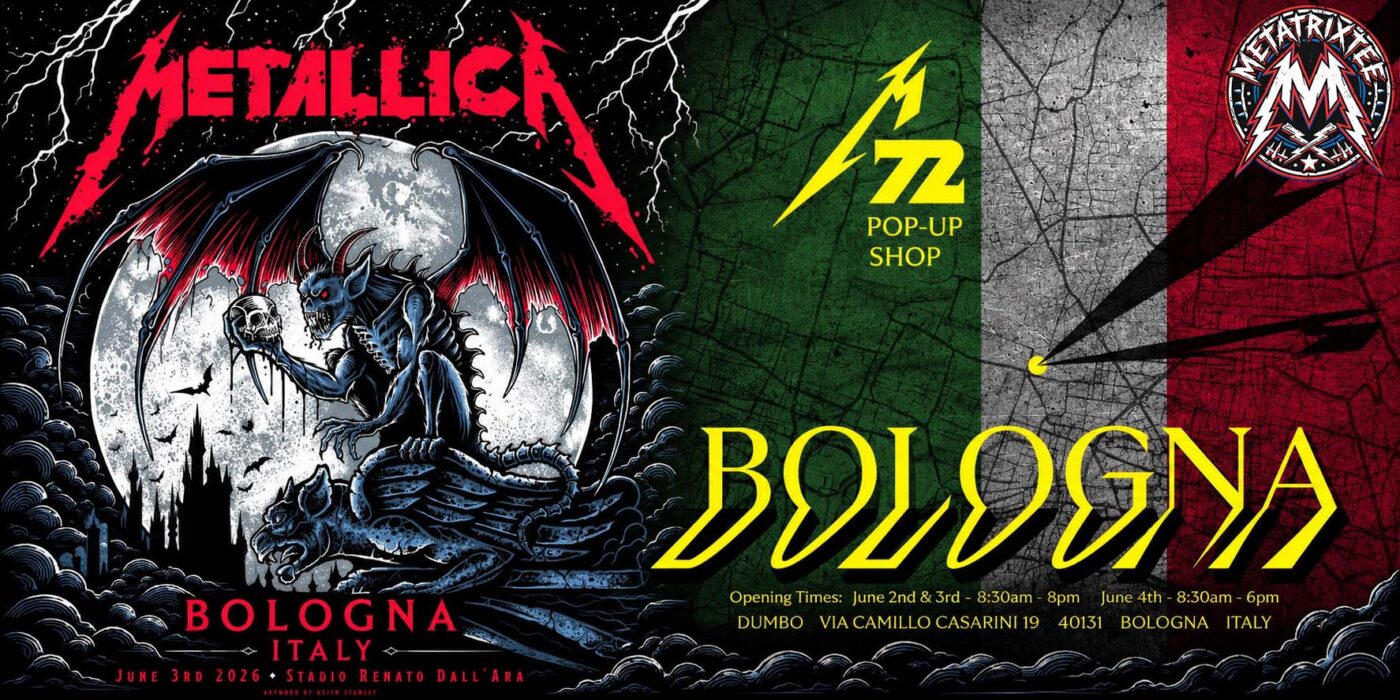
Thunder Echoing Through An Ancient Sanctuary: Metallica And The M72 Ritual In Bologna
Jun
Table of Contents
Amber light before the storm
Bologna in early June carries a distinct humidity native to the Po Valley, where the initial summer heat begins to seep into the centuries-old red brick of the city’s medieval towers. As dusk falls, the city does not settle into its usual quietude. Instead, a low, unfamiliar rhythm takes over. A low rumble rises from thousands of footsteps converging on the western side of the city, moving steadily toward the Costa Saragozza district. This is not the sound of a standard weekend gathering.
Underneath the historic porticoes that have sheltered walkers for generations, a steady stream of people clad in faded black t-shirts moves in silence. The sharp tap of boots on ancient cobblestones and the faint metallic click of chains blend with a murmur of multiple European languages. The fading amber sunlight catches the terracotta walls, creating a cinematic backdrop that feels simultaneously solemn and rebellious. There are no megaphone announcements, no loud introductions—only a dense atmosphere of shared anticipation, an invisible energy coiling tightly before the sonic storm arrives.
Where classical heritage meets heavy metal
Italy has always held a unique position on the international touring map, but choosing Bologna over industrialized entertainment hubs like Milan or Rome offers a deeper editorial resonance. This is a city defined by scholars, preservation, and classical foundations, home to the oldest university in the Western world. Its spirit is inherently academic. Dropping a heavy-duty rock machine into the middle of such a landscape creates a striking, beautiful friction.
The ongoing M72 World Tour is more than an arena spectacle; it functions as a recontextualization of how heavy music interacts with local history. The Stadio Renato Dall’Ara, with its monumental Marathon Tower dating back to the 1920s, provides the perfect amphitheater for this dialogue. The stadium’s red-brick, neo-classical architecture does not reject the abrasive output of four musicians who have spent over forty years defining the genre; rather, it encloses and amplifies it. This specific stop for Metallica Italy becomes a cultural collision where contemporary subculture meets timeless European architecture.
The M72 machine descends
Moving inward from the surrounding residential streets, the perspective narrows sharply as the crowd filters through the steel security gates into the concrete bowl of the stadium. The elliptical shape of the Stadio Renato Dall’Ara opens up into an overwhelming vista where the central pitch has been completely covered to support a massive engineering marvel. The signature circular stage engineered for this tour sits directly in the center, removing the traditional barrier between performer and listener.
The “Snake Pit” at the center of the ring acts as a vortex, drawing in the gaze and the focus of the entire crowd. No collection of technical specifications can replicate the physical sensation of standing beneath the massive loudspeaker towers ringing the stadium. The heat of thousands of gathered bodies creates a tangible change in air pressure. Brief bursts of soundcheck cut through the air, each thud of the bass drum vibrating through the floorboards. Conversations die down; thousands of eyes fixate on the center ring where microphones stand silent under a cold, industrial blue glow.
Between collective memory and cathartic noise
When the first chords finally cut through the air, the entire arena transforms into an environment of high-fidelity, unvarnished thrash metal. The draw of the performance is no longer about raw youthful aggression or sheer speed; it lies in the unspoken understanding between the band and the audience. The concert evolves into a shared ritual where older fans with graying hair stand shoulder-to-shoulder with twenty-year-olds, all responding to the exact same frequency.
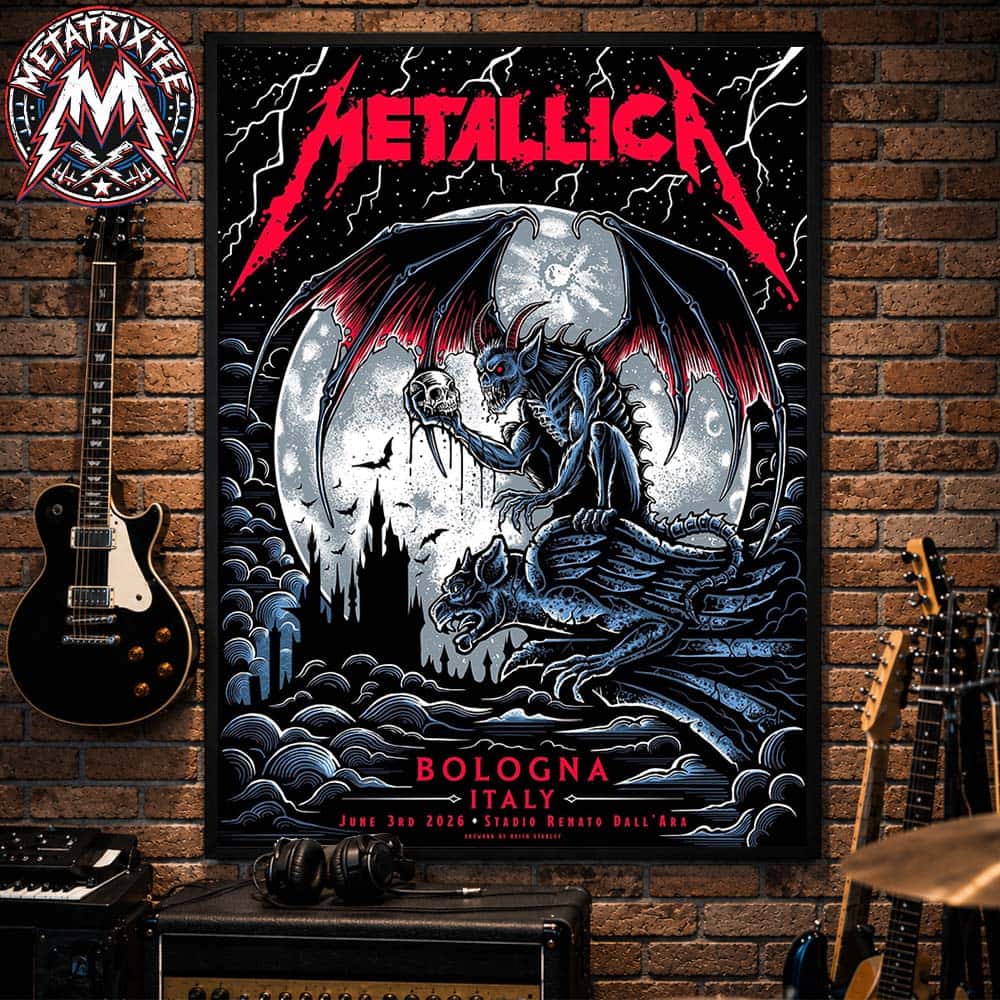
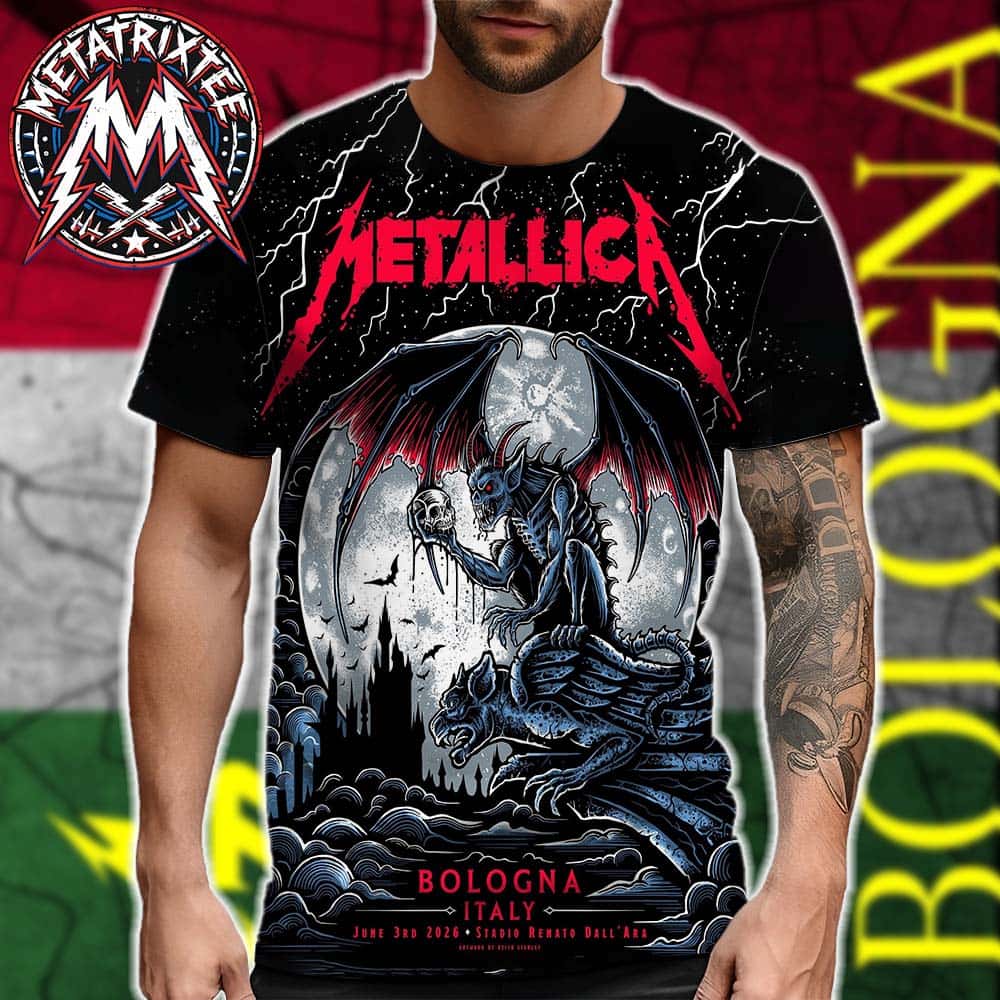
The crowd filling the Stadio Renato Dall’Ara proves that these songs have transitioned from simple physical media into elements of personal identity. Throughout the stands, people carry distinct mementos representing their journey. Many choose to preserve this moment in time through an authentic Metallica Bologna tour shirt, a physical marker proving they were part of this specific night. Carrying a piece of the event provides a lasting connection to a global community of like-minded individuals.


Every historic venue on the European continent brings its own architectural atmosphere to the performance. To see how the band adapts to different monumental spaces, you can explore our analysis of the stadium scale experience in Berlin.
This type of performance does not seek to comfort the listener with easy melodies. It offers a form of sonic catharsis, using organized noise to clear away daily anxieties and forcing the individual to exist purely in the physical present.
The reverberation left behind
As the final lights dim and the hum of the amplifiers dies away, the interior of the stadium returns to a heavy, resonant silence. The scent of stage effects, sweat, and the residual warmth of the crowd lingers in the night air. This chapter of the Metallica Bologna 2026 campaign does not leave the audience with a sense of emptiness, but rather the quiet satisfaction of a long journey fulfilled.
The crowd spills back out into the narrow streets of Bologna, their pace notably slower and more relaxed than before. Underneath the historic porticoes, faint whistling of classic melodies echoes off the brickwork. The show is over, but the resonance of the event will stay within the walls of the city long after the trucks have packed up. It leaves behind a quiet reminder that as long as these ancient structures stand and guitars remain plugged in, heavy music will always find a home.
